
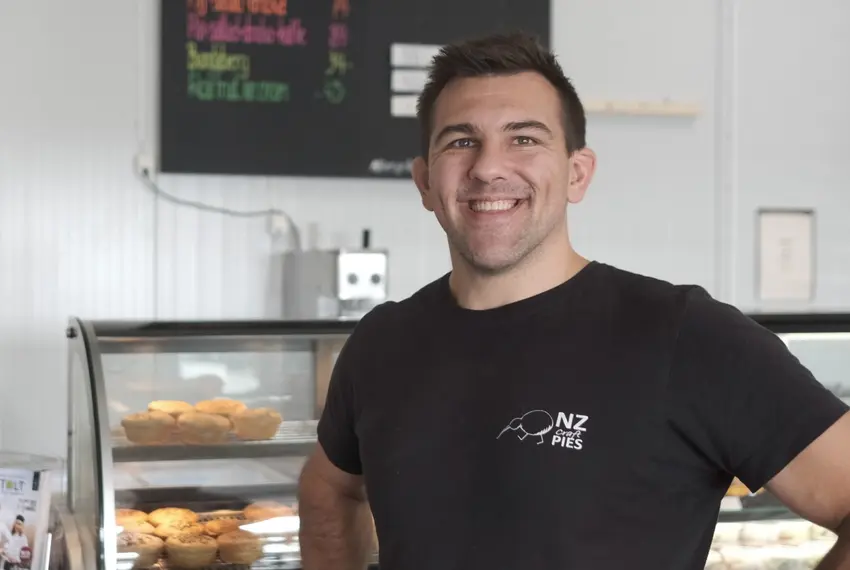
Tom knew a fair amount about Sweden before he moved here, due in part to the fact that his wife, who he met back home in New Zealand, is Swedish.
“We lived there and got married there, and then decided to come over here for an adventure,” he tells The Local.
A trained food scientist, he landed a job at KTH Royal Institute of Technology in Stockholm, which led to a lot of travelling around and working in sales in the Swedish food industry.
“I saw that there were a lot of things you couldn’t get, so I opened a small import business, like a side hustle, when I was working at a municipality. It was fun, I was importing stuff out of New Zealand and it went quite well.”
During his work, Tom had noticed that there were no New Zealand-style pies or other similar products on sale in Sweden, and started to wonder if bringing pies to Sweden could be a good business opportunity.
What is a New Zealand-style pie?
In Sweden, a paj is more similar to what English speakers would refer to as tarts or quiches – a pastry crust filled with an egg-based savoury custard, known as an äggstanning, and other fillings like pieces of cheese, meat or vegetables.
In New Zealand, as well as in the UK, Australia and South Africa, savoury pies consist of a filling completely encased in flaky pastry, often served in individual hand-sized portions for takeaway.
“If you speak Swedish to them, they understand that, because you say matpaj,” he explains. “But then you explain that there’s no äggstanning, it’s a proper filling with different colours and flavours and textures and smells, and they’re just like ‘whoa, give me some of that’.”
He had previously worked in his stepmother’s bakery back in New Zealand, so he already knew the basics when it came to pie production.
“I decided to have a crack at it, resigned from my job in September 2015 and started work around the same time my second son was born. So in January 2016 I started a company working out of my house and subleased a kitchen at the restaurant school in Katrineholm, where we’re based, and had that on weekends when they weren’t using it.”
Leaving the garage for bigger things
“I baked as many pies as I possibly could over a weekend, rebuilt my garage into freezer storage and managed to talk the biggest logistics company in Scandinavia into having me as a customer.”
This led to customers in Stockholm, Gothenburg and even further afield in Finland. Sales took off, and the company ‒ which by this point had been christened NZ Pies ‒ quickly outgrew the family’s home.
“We were shipping out of my garage, which was pretty funny. The trucks turned up and were always like ‘what the heck is this?’ So we had to find a premises which was both usable and affordable, and had some scale and some growth.”
Tom had to import “heaps of equipment” in order to make the pies on an industrial scale, such as special tins to bake them into the right shape.
“We had to do everything on the smallest possible budget, but we found a building that was brand new and they wanted tenants. They had several lots inside the same building, so we took a chunk."
By 2017, things were moving quickly.
“We had a tiny little hole-in-the-wall factory shop in the same unit. We had everything on this one lot. It was super hot during the summers with all the gear and we just got more and more customers, and more demand, so we went for it and took over two more premises in the same building, which was eight times the size of what we had.”
They had to “beg, steal and borrow” to fund the expansion, contacting as many banks as possible for financing.
In 2018, NZ Pies had started selling their products to local supermarkets while running a larger factory shop and a cafe on the same site, which meant they could test new products directly with consumers.
Four years later, in 2022, the company was centrally listed with ICA, which means that the owners of every ICA store in Sweden can choose to stock their products in their local supermarkets.
“ICA Sverige is a wholesaler, essentially, which is owned by all the ICA supermarkets, and the supermarkets buy from their own wholesaler. So in theory they have 100 percent freedom to choose what they want and at what price and everything, which is a challenge for a supplier because you have to be really active.”
The company’s pies are also available in some Coop and Hemköp stores.
'They love new stuff but they're hyper conservative'
As to how to market a product in a way that appeals to Swedes, Tom says that the Swedish market in some ways is “kind of like a split personality”.
“On the one side, they love new stuff, but on the other side they’re hyper conservative. Obviously the country is not homogeneous, you have some areas that are really affluent while others aren’t, and then there are some areas that are very ethnically Swedish and others that have lots of immigrants.”
He adds that the positive image of New Zealand in Sweden was one of the reasons for the company's name.
“There’s a lot of good will towards New Zealand. Most people here get a warm, fuzzy feeling when they think about New Zealand, and there’s this curiosity. People have heard of hobbits and whatever – sheep, rugby, whatever stereotypes they might have about the country – but not pies, you know, ‘what’s that?’.”
“Then you just have to make sure the product is good so that when they eat them they think ‘oh man, these were definitely much better than the status quo.”
Pies aren’t just a quick snack in New Zealand, but a major part of the culture, Tom says.
“It’s quite a gourmet pie market, with people making pies from the cheapest to the most expensive option – I think the most expensive one is like 50 or 60 dollars, some crazy oyster thing.”
But Tom’s pies are a lot more conservative in their flavours.
“I don’t believe it would work to take something outlandish, take something made for a New Zealand market. A pie in itself is already outlandish for Swedes. You have to take something foreign and then make it something that Swedes recognise.”
This is partly the reason for the company’s taco pie, which makes the most of Sweden’s love of Tex-Mex-style tacos.
“It’s interesting though, because the most popular pie down there is mince and cheese. And that’s the one everyone loves here too. So they’re not worlds apart. They love meat, and back home we love meat pies.”
“They’re very similar countries. I think that’s why you find a lot of Swedes living over there and a lot of Kiwis here, because we see the world in a very similar way.”
'Everything takes way longer than you think'
So, what is Tom’s advice for any other immigrants in Sweden thinking of starting a food company?
“Being a Swedish speaker and having worked in both the private and public sector, I was able to navigate my way through most of it without too many problems,” he says.
“This is probably not unique for Sweden, but everything takes way longer than you think, it’s way harder and is way more expensive. I think if you knew how hard it was going to be when you start, you would never have started. Sometimes you just need to build a business plan and just go for it. Don’t think about it too much, because you’ll just cramp up.”
He says that one of the major pieces of advice for anyone looking to get into the Swedish market is knowing your strengths and identifying where you will need help.
“Understand what you can bring and what your unique selling point is, and understand where you’re not going to be good. For a lot of immigrants that’s the language barrier or not understanding how the market works. So get help where you’re not strong and also, try to zoom out. You end up very quickly in the everyday grind with your sleeves rolled up.”
In the long run, planning ahead at the start can help you reach your goals along the way, he says.
“You have to understand where you’re going with this, how big is the potential? Is there scalability? Can this scale up into something bigger, can we sell it? And my advice would be to do that homework at the start so you’re not doing it on the fly three years in.”
Soon, NZ Pies will be offering their products for sale directly to consumers on their website, in part to make it easier to reach people in more remote areas of Sweden.
“We’re going to be starting up e-commerce, so people can order from home and get home delivery frozen. Sweden’s very large, and it’s hard to get distribution in these tiny towns or small areas. It’s not so hard in Stockholm, Gothenburg or Malmö, where there’s lots of people, but getting a small store to take in a new product… they’re more conservative, more price sensitive.”
“We need to get to all these Poms [Brits], Australians and Kiwis that are hidden all over the place!”
Comments